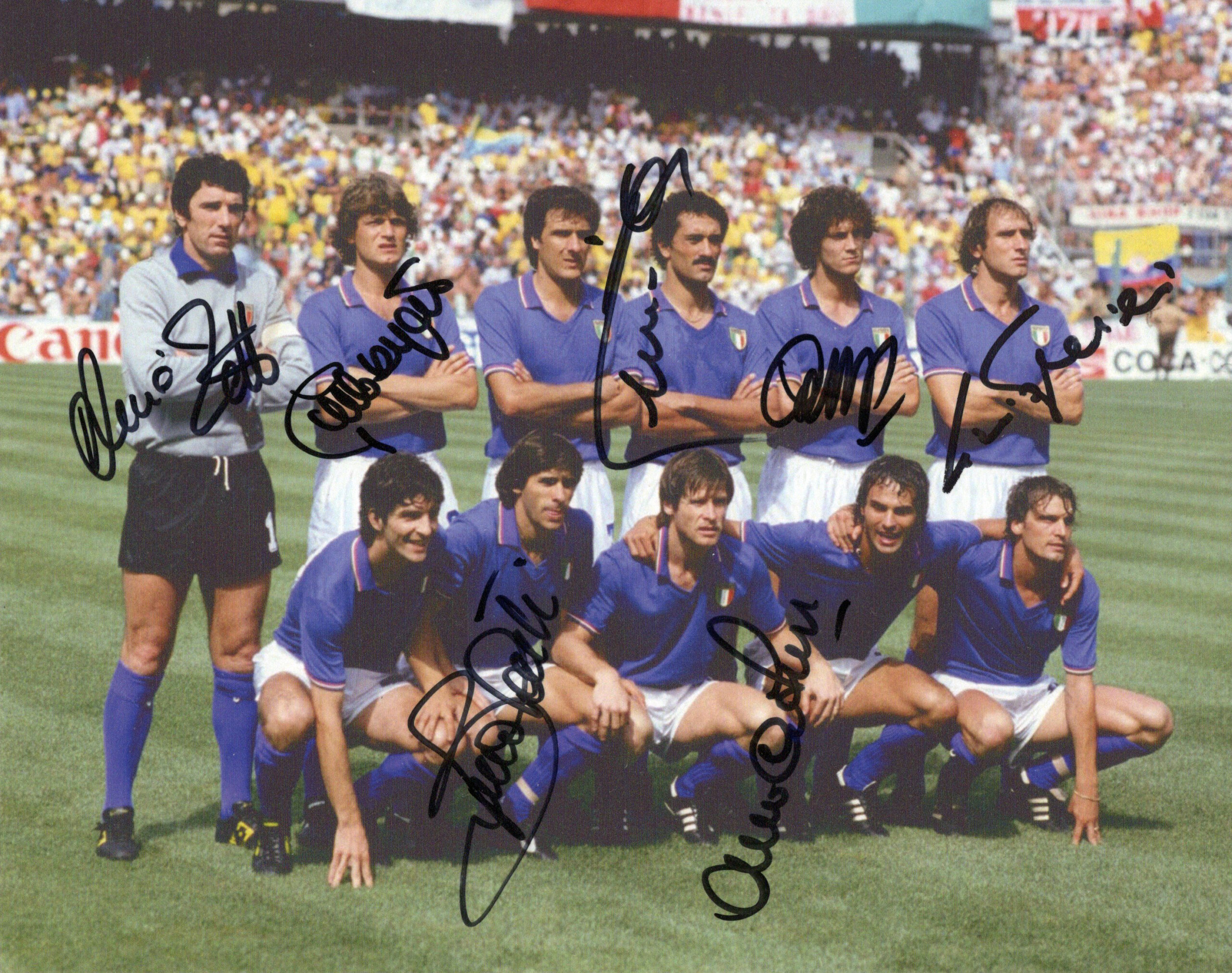


Description
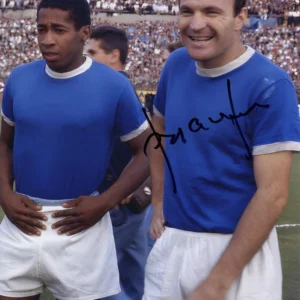
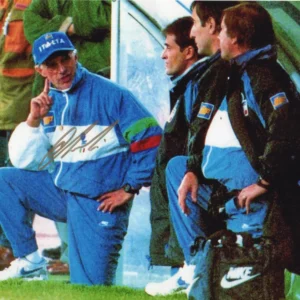
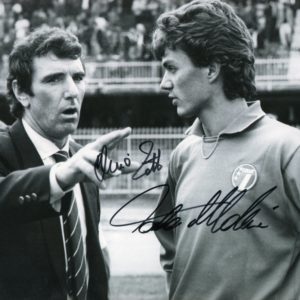
DINO ZOFF BIOGRAPHY :
Dino Zoff (born 28 February 1942) is an Italian former professional footballer who played as a goalkeeper. He is the oldest ever winner of the World Cup, which he earned as captain of the Italian national team in the 1982 tournament, at the age of 40 years, 4 months and 13 days. He also won the award for best goalkeeper of the tournament and was elected to the team of the tournament for his performances, keeping two clean-sheets, an honour he also received after winning the 1968 European Championship on home soil. Zoff is the only Italian player to have won both the World Cup and the European Championship. He also achieved great club success with Juventus, winning six Serie A titles, two Coppa Italia titles, and a UEFA Cup, also reaching two European Champions’ Cup finals in the 1972–73 and 1982–83 seasons, as well as finishing second in the 1973 Intercontinental Cup final. Zoff was a goalkeeper of outstanding ability, and he has a place in the history of the sport among the very best in this role, being named the third greatest goalkeeper of the 20th century by the IFFHS behind Lev Yashin and Gordon Banks. He holds the record for the longest playing time without allowing goals in international tournaments (1,142 minutes) set between 1972 and 1974. With 112 caps, he is the sixth most capped player for the Italy national team. In 2004, Pelé named Zoff as one of the 100 greatest living footballers. In the same year, Zoff placed fifth in the UEFA Golden Jubilee Poll, and was elected as Italy’s golden player of the past 50 years. He also placed second in the 1973 Ballon d’Or, as he narrowly missed out on a treble with Juventus. In 1999, Zoff placed 47th in World Soccer Magazine’s 100 Greatest Players of the Twentieth Century. After retiring as a footballer, Zoff went on to pursue a managerial career, coaching the Italian national team, with which he reached the Euro 2000 Final, losing to Team France, and several Italian club teams, including his former club Juventus, with which he won an UEFA Cup and a Coppa Italia double during the 1989–90 season, trophies he had also won as a player. In September 2014, Zoff published his Italian autobiography Dura solo un attimo, la gloria (“Glory only Lasts a Moment”).
Dino Zoff (born 28 February 1942) is an Italian former professional footballer who played as a goalkeeper. He is the oldest ever winner of the World Cup, which he earned as captain of the Italian national team in the 1982 tournament, at the age of 40 years, 4 months and 13 days. He also won the award for best goalkeeper of the tournament and was elected to the team of the tournament for his performances, keeping two clean-sheets, an honour he also received after winning the 1968 European Championship on home soil. Zoff is the only Italian player to have won both the World Cup and the European Championship. He also achieved great club success with Juventus, winning six Serie A titles, two Coppa Italia titles, and a UEFA Cup, also reaching two European Champions’ Cup finals in the 1972–73 and 1982–83 seasons, as well as finishing second in the 1973 Intercontinental Cup final. Zoff was a goalkeeper of outstanding ability, and he has a place in the history of the sport among the very best in this role, being named the third greatest goalkeeper of the 20th century by the IFFHS behind Lev Yashin and Gordon Banks. He holds the record for the longest playing time without allowing goals in international tournaments (1,142 minutes) set between 1972 and 1974. With 112 caps, he is the sixth most capped player for the Italy national team. In 2004, Pelé named Zoff as one of the 100 greatest living footballers. In the same year, Zoff placed fifth in the UEFA Golden Jubilee Poll, and was elected as Italy’s golden player of the past 50 years. He also placed second in the 1973 Ballon d’Or, as he narrowly missed out on a treble with Juventus. In 1999, Zoff placed 47th in World Soccer Magazine’s 100 Greatest Players of the Twentieth Century. After retiring as a footballer, Zoff went on to pursue a managerial career, coaching the Italian national team, with which he reached the Euro 2000 Final, losing to Team France, and several Italian club teams, including his former club Juventus, with which he won an UEFA Cup and a Coppa Italia double during the 1989–90 season, trophies he had also won as a player. In September 2014, Zoff published his Italian autobiography Dura solo un attimo, la gloria (“Glory only Lasts a Moment”).
ANTONIO CABRINI BIOGRAPHY :
Antonio Cabrini (born 8 October 1957) is an Italian professional football manager and a former player. He has played left-back, mainly with Juventus. He won the 1982 FIFA World Cup with the Italian national team. Cabrini was nicknamed Bell’Antonio (“beautiful Antonio”), because of his popularity as a charismatic and good-looking football player. On the field, he made a name for himself as one of Italy’s greatest defenders ever, and is remembered in particular for forming one of the most formidable defensive units of all time with Italy and Juventus, alongside goalkeeper Dino Zoff, as well as defenders Claudio Gentile, and Gaetano Scirea. Cabrini won the Best Young Player Award at the 1978 World Cup, after helping Italy managed a fourth-place finish, and also represented Italy at Euro 1980, once again finishing in fourth place. He is one of the few players to have won all UEFA Club competitions, an achievement he managed with Juventus.
Club career
Cabrini was born in Cremona, Lombardy. He made his professional football debut with the local team U.S. Cremonese in the Serie C during the 1973–74 season, making 3 appearances and gaining a starting place the following 1974–75 season. In the 1975–76 season he played in the Serie B for Atalanta, and in the summer of 1976 he was acquired by Juventus, the team for which he was to spend most of his career. With Juventus, he won the Italian Serie A 6 times, the Coppa Italia 2 times (Italian Cup), 1 UEFA Super Cup, 1 UEFA Champions League, 1 UEFA Cup and 1 Intercontinental European/South American Cup. In his final season with Juventus, he also captained the side, after inheriting the armband from Scirea. In 1989, after 13 successful seasons with the Turin club, he moved to Bologna for two more years before retiring as a player. He played a total of 352 Serie A matches (297 of them with Juventus), scoring 35 goals (33 of them with Juventus).
International career
Cabrini was called up to Italy’s being part of the list of 20 players to participate in the 1978 FIFA World Cup despite being uncapped (he however, had 23 caps for junior teams). He earned his first cap on 2 June 1978, in Italy’s opening game against France, which ended in a 2–1 win to the “Azzurri”; Italy went on to finish the tournament in fourth place, and Cabrini was named the Best Young Player of the Tournament. He soon became an international regular for the next 9 years; he participated as a starter in all of Italy’s games in 3 consecutive World Cups: in 1978, 1982 and 1986. Overall, Cabrini played 18 games during World Cup final stages, winning the 1982 edition despite missing a penalty in the final against West Germany. He also represented Italy at Euro 1980 as a starter on home soil, finishing the tournament in fourth place, after reaching the semi-finals. Cabrini was part of the 1982 World Cup-winning team that included goalkeeper Dino Zoff, Gaetano Scirea, Giuseppe Bergomi, Claudio Gentile in defense, Marco Tardelli and Bruno Conti in midfield, and Cabrini’s Juventus teammate Paolo Rossi in attack. Cabrini gave a strong performance throughout the tournament, helping to lead his country to win the title, keeping two clean sheets throughout the tournament, but also scoring the crucial match-winning goal in Italy’s 2–1 second round win over defending champions Argentina. In total, he earned 73 caps for his country and scored 9 goals (an Italy international record for a defender), ending his career with the Azzurri in October 1987, earning his final appearance on 17 October 1987, in a 0–0 draw against Switzerland. He also captained the national side 10 times.
Club career
Cabrini was born in Cremona, Lombardy. He made his professional football debut with the local team U.S. Cremonese in the Serie C during the 1973–74 season, making 3 appearances and gaining a starting place the following 1974–75 season. In the 1975–76 season he played in the Serie B for Atalanta, and in the summer of 1976 he was acquired by Juventus, the team for which he was to spend most of his career. With Juventus, he won the Italian Serie A 6 times, the Coppa Italia 2 times (Italian Cup), 1 UEFA Super Cup, 1 UEFA Champions League, 1 UEFA Cup and 1 Intercontinental European/South American Cup. In his final season with Juventus, he also captained the side, after inheriting the armband from Scirea. In 1989, after 13 successful seasons with the Turin club, he moved to Bologna for two more years before retiring as a player. He played a total of 352 Serie A matches (297 of them with Juventus), scoring 35 goals (33 of them with Juventus).
International career
Cabrini was called up to Italy’s being part of the list of 20 players to participate in the 1978 FIFA World Cup despite being uncapped (he however, had 23 caps for junior teams). He earned his first cap on 2 June 1978, in Italy’s opening game against France, which ended in a 2–1 win to the “Azzurri”; Italy went on to finish the tournament in fourth place, and Cabrini was named the Best Young Player of the Tournament. He soon became an international regular for the next 9 years; he participated as a starter in all of Italy’s games in 3 consecutive World Cups: in 1978, 1982 and 1986. Overall, Cabrini played 18 games during World Cup final stages, winning the 1982 edition despite missing a penalty in the final against West Germany. He also represented Italy at Euro 1980 as a starter on home soil, finishing the tournament in fourth place, after reaching the semi-finals. Cabrini was part of the 1982 World Cup-winning team that included goalkeeper Dino Zoff, Gaetano Scirea, Giuseppe Bergomi, Claudio Gentile in defense, Marco Tardelli and Bruno Conti in midfield, and Cabrini’s Juventus teammate Paolo Rossi in attack. Cabrini gave a strong performance throughout the tournament, helping to lead his country to win the title, keeping two clean sheets throughout the tournament, but also scoring the crucial match-winning goal in Italy’s 2–1 second round win over defending champions Argentina. In total, he earned 73 caps for his country and scored 9 goals (an Italy international record for a defender), ending his career with the Azzurri in October 1987, earning his final appearance on 17 October 1987, in a 0–0 draw against Switzerland. He also captained the national side 10 times.
BRUNO CONTI BIOGRAPHY :
Bruno Conti (born 13 March 1955) is an Italian football manager and former player. He coached Serie A club Roma from 14 March 2005 to 30 June 2005; he is currently head of the club’s youth sector. Throughout his playing career, he was usually deployed as a winger, and also previously played for Roma, where he spent his entire club career, aside from two season-long loan spells with Genoa in the 1970s. He is considered by many in the sport to be one of the greatest Italian players of all time in his position. Nicknamed “The Mayor of Rome”, he was an important figure in the club’s history, and won a league title as well as five Coppa Italia titles during his time in the Italian capital. At international level, he was notably a member of Italy’s 1982 FIFA World Cup winning team, and also took part at the 1986 FIFA World Cup.
Club career
Conti spent his entire career, aside from two year-long loan spells at Genoa in Serie B during the 1975–76 (during which he won the Serie B title) and the 1978–79 seasons, at Roma. He had initially been a member of the club’s youth squad between 1972 and 1974, eventually making his senior club and Serie A debut on 10 February 1974, in a 0–0 home draw against Torino, during the 1973–74 Season, under Nils Liedholm, at the age of 19. As a youngster, he had been overlooked by scouts during trials with several professional clubs, including Roma manager Helenio Herrera, who felt that his physique would not allow him to succeed at the top level, despite his talent. During his time with the Roma, Conti famously wore the number 7 shirt, and he became an important figure with the club on the right wing, as he won the Scudetto during the 1982–83 season and the Coppa Italia five times between 1979 and 1991. He played a key role in helping Roma to reach the 1984 European Cup Final, where they were defeated on penalties by Liverpool, with Conti missing his penalty in the shootout. He also helped Roma to reach the 1991 UEFA Cup Final, during his final season with the club, also winning his final Coppa Italia that season. Due to his performances for Roma throughout his club career, Conti was given the nickname: “The Mayor of Rome”. He was one of the eleven members to be inducted into the A.S. Roma Hall of Fame in 2012.
Conti spent his entire career, aside from two year-long loan spells at Genoa in Serie B during the 1975–76 (during which he won the Serie B title) and the 1978–79 seasons, at Roma. He had initially been a member of the club’s youth squad between 1972 and 1974, eventually making his senior club and Serie A debut on 10 February 1974, in a 0–0 home draw against Torino, during the 1973–74 Season, under Nils Liedholm, at the age of 19. As a youngster, he had been overlooked by scouts during trials with several professional clubs, including Roma manager Helenio Herrera, who felt that his physique would not allow him to succeed at the top level, despite his talent. During his time with the Roma, Conti famously wore the number 7 shirt, and he became an important figure with the club on the right wing, as he won the Scudetto during the 1982–83 season and the Coppa Italia five times between 1979 and 1991. He played a key role in helping Roma to reach the 1984 European Cup Final, where they were defeated on penalties by Liverpool, with Conti missing his penalty in the shootout. He also helped Roma to reach the 1991 UEFA Cup Final, during his final season with the club, also winning his final Coppa Italia that season. Due to his performances for Roma throughout his club career, Conti was given the nickname: “The Mayor of Rome”. He was one of the eleven members to be inducted into the A.S. Roma Hall of Fame in 2012.
CLAUDIO GENTILE BIOGRAPHY :
Claudio Gentile (born 27 September 1953 in Tripoli, Libya) is an Italian association football manager and former defender of the 1970s and 1980s. Gentile appeared for Italy in two World Cup tournaments, and played for the winning Italian team in the 1982 final. His club career was notably spent with Juventus for whom he made almost 300 league appearances, winning six national titles and two major European trophies.
Club career
After beginning his career with Arona, Gentile played in Serie B with Varese during the 1972–73 season. He then moved to Juventus and first played for them in a Coppa Italia match against Ascoli Calcio on 29 August 1973, with his Serie A debut following on 2 December 1973 against Verona. In all he played 414 senior matches for Juventus, including 283 in Serie A. In over a decade with Juventus, Gentile won two major European club competitions (1976–77 UEFA Cup and 1983–84 European Cup Winners’ Cup), six Serie A championships, and two Coppa Italias. He also reached the final of the 1982–83 European Cup with the Turin club, only to suffer a 1–0 defeat against Hamburg in Athens. In 1984, he moved to rivals Fiorentina where he spent three further seasons in Serie A, making over 60 appearances for the club. He then played a final season with Piacenza, in Serie B, retiring at the end of the 1987–88 season.
International career
Gentile was capped on 71 occasions by Italy between 1975 and 1984, scoring a single goal during his international career. He played in all of Italy’s matches at the 1978 World Cup, where Italy finished in fourth place, after reaching second place in the final group stage of the tournament and then losing the 3rd place playoff to Brazil. Gentile also played in the 1980 European Championship, and he was named in the team of the tournament. In the 1982 World Cup, Gentile was once again a permanent member of the starting line-up as Italy went on to win the World Cup that year. He gained notoriety for his aggressive man-marking of Diego Maradona in a 2–1 second-round victory against Argentina at the 1982 World Cup, where he fouled the Argentine star 11 times in the first half, and 23 in total, after which Gentile famously quipped,”Football is not for ballerinas!” Italy ending up defeating the defending champions Argentina 2–1. Italy then faced tournament favorites Brazil in the next second-round group match and won 3–2. Paolo Rossi had a hat trick. Italy defeated Poland 2–0 in the semi-final, and Gentile returned for the final against West Germany where Italy won 3–1. Gentile was once again in the team of the tournament for his performances during the 1982 World Cup.
After beginning his career with Arona, Gentile played in Serie B with Varese during the 1972–73 season. He then moved to Juventus and first played for them in a Coppa Italia match against Ascoli Calcio on 29 August 1973, with his Serie A debut following on 2 December 1973 against Verona. In all he played 414 senior matches for Juventus, including 283 in Serie A. In over a decade with Juventus, Gentile won two major European club competitions (1976–77 UEFA Cup and 1983–84 European Cup Winners’ Cup), six Serie A championships, and two Coppa Italias. He also reached the final of the 1982–83 European Cup with the Turin club, only to suffer a 1–0 defeat against Hamburg in Athens. In 1984, he moved to rivals Fiorentina where he spent three further seasons in Serie A, making over 60 appearances for the club. He then played a final season with Piacenza, in Serie B, retiring at the end of the 1987–88 season.
International career
Gentile was capped on 71 occasions by Italy between 1975 and 1984, scoring a single goal during his international career. He played in all of Italy’s matches at the 1978 World Cup, where Italy finished in fourth place, after reaching second place in the final group stage of the tournament and then losing the 3rd place playoff to Brazil. Gentile also played in the 1980 European Championship, and he was named in the team of the tournament. In the 1982 World Cup, Gentile was once again a permanent member of the starting line-up as Italy went on to win the World Cup that year. He gained notoriety for his aggressive man-marking of Diego Maradona in a 2–1 second-round victory against Argentina at the 1982 World Cup, where he fouled the Argentine star 11 times in the first half, and 23 in total, after which Gentile famously quipped,”Football is not for ballerinas!” Italy ending up defeating the defending champions Argentina 2–1. Italy then faced tournament favorites Brazil in the next second-round group match and won 3–2. Paolo Rossi had a hat trick. Italy defeated Poland 2–0 in the semi-final, and Gentile returned for the final against West Germany where Italy won 3–1. Gentile was once again in the team of the tournament for his performances during the 1982 World Cup.
FULVIO COLLOVATI BIOGRAPHY :
Fulvio Collovati (born 9 May 1957) is an Italian former footballer, who played as a defender. He was a stopper (a man–marking centre-back in Italian football jargon) and also played for Italy at international level, winning the 1982 FIFA World Cup. As a player, he was regarded as one of Italy’s best defenders during the 1970s and 1980s. An elegant, physically strong, and dynamic player, he was gifted with good technique and distribution, as well as excellent anticipation, movement, marking ability, heading, and aerial prowess; because of his many defensive attributes, he was considered Roberto Rosato’s heir at Milan.
Fulvio Collovati (born 9 May 1957) is an Italian former footballer, who played as a defender. He was a stopper (a man–marking centre-back in Italian football jargon) and also played for Italy at international level, winning the 1982 FIFA World Cup. As a player, he was regarded as one of Italy’s best defenders during the 1970s and 1980s. An elegant, physically strong, and dynamic player, he was gifted with good technique and distribution, as well as excellent anticipation, movement, marking ability, heading, and aerial prowess; because of his many defensive attributes, he was considered Roberto Rosato’s heir at Milan.
Club career
Collovati was born in Teor, in the province of Udine. Brought up through the A.C. Milan youth academy, he debuted in Serie A with the rossoneri in the 1976–77 season, in which he played eleven times and even won the Coppa Italia. In the next season he played more regularly (25 appearances, 1 goal) but his definitive moment came during the 1978–79 season in which, thanks to his 27 appearances, he won the scudetto. Following the 1979–80 season, Milan was relegated to the Serie B for their involvement in the Totonero football betting scandal. Unlike other players, Collovati stayed on with Milan in Serie B and played 36 games scoring two goals, winning the league title that season, and helping the club to regain promotion to Serie A the following season. Back in Serie A the next season, Milan won the Mitropa Cup with Collovati serving as the team’s captain: however Milan was relegated to Serie B once again, but this time for their on-field exploits. On this occasion, Collovati (who in the meantime was called up to the Nazionale) decided to join local rivals Inter Milan. In his first year with the nerazzurri (1982–83), he played in 28 games. At Inter he was always a mainstay in the defense, but in September 1986 he wanted to be closer to his hometown of Udine and he went to play for Udinese Calcio, where he only stayed for one season (20 games, 2 goals). He ended his career after two years at A.S. Roma (1987–88 and 1988–89) and four at Genoa C.F.C. (from 1989–90 to 1992–93), all in Serie A.
International career
In his international career, Collovati played 50 games and scored 3 goals: he made his senior debut for Italy on 24 February 1979 against the Netherlands (3–0) and he scored his first international goal on 16 February 1980 during Italy–Romania (2–1). Collovati was a member of the Italy squad that finished in fourth place at the 1980 European Championships on home soil, missing the decisive penalty in the shoot-out of the bronze-medal match against Czechoslovakia. Collovati represented his country in 8 FIFA World Cup qualification matches and was a protagonist at the 1982 World Cup in Spain where Italy won the World Cup for a third time, and Collovati was named as a member of the team of the tournament. He also made an appearance for Italy at the 1986 World Cup.
Collovati was born in Teor, in the province of Udine. Brought up through the A.C. Milan youth academy, he debuted in Serie A with the rossoneri in the 1976–77 season, in which he played eleven times and even won the Coppa Italia. In the next season he played more regularly (25 appearances, 1 goal) but his definitive moment came during the 1978–79 season in which, thanks to his 27 appearances, he won the scudetto. Following the 1979–80 season, Milan was relegated to the Serie B for their involvement in the Totonero football betting scandal. Unlike other players, Collovati stayed on with Milan in Serie B and played 36 games scoring two goals, winning the league title that season, and helping the club to regain promotion to Serie A the following season. Back in Serie A the next season, Milan won the Mitropa Cup with Collovati serving as the team’s captain: however Milan was relegated to Serie B once again, but this time for their on-field exploits. On this occasion, Collovati (who in the meantime was called up to the Nazionale) decided to join local rivals Inter Milan. In his first year with the nerazzurri (1982–83), he played in 28 games. At Inter he was always a mainstay in the defense, but in September 1986 he wanted to be closer to his hometown of Udine and he went to play for Udinese Calcio, where he only stayed for one season (20 games, 2 goals). He ended his career after two years at A.S. Roma (1987–88 and 1988–89) and four at Genoa C.F.C. (from 1989–90 to 1992–93), all in Serie A.
International career
In his international career, Collovati played 50 games and scored 3 goals: he made his senior debut for Italy on 24 February 1979 against the Netherlands (3–0) and he scored his first international goal on 16 February 1980 during Italy–Romania (2–1). Collovati was a member of the Italy squad that finished in fourth place at the 1980 European Championships on home soil, missing the decisive penalty in the shoot-out of the bronze-medal match against Czechoslovakia. Collovati represented his country in 8 FIFA World Cup qualification matches and was a protagonist at the 1982 World Cup in Spain where Italy won the World Cup for a third time, and Collovati was named as a member of the team of the tournament. He also made an appearance for Italy at the 1986 World Cup.
GIUSEPPE BERGOMI BIOGRAPHY :
Giuseppe “Beppe” Bergomi (born 22 December 1963) is an Italian former professional footballer who spent his entire career at Internazionale. A one-club man, Bergomi held the record of most appearances for the club for several years, while also being the side’s longtime captain. He was affectionately referred to as “Lo zio” (“the uncle”) because of his bushy eyebrows and the impressive moustache he wore even as a youngster. He is regarded as one of the greatest Italian defenders of all time, and as one of the best of his generation, being elected by Pelé to be part of the FIFA 100 in 2004. Bergomi currently works as a pundit at Sky Sports Italia and frequently co-commentates on Serie A matches alongside Fabio Caressa.
Club career
Born in Milan, Bergomi began training with F.C. Internazionale Milano’s first team at the age of only 16, and made his professional debut in the 1980–81 season. After winning the Coppa Italia the following year, go on to spend his entire career with Inter, later becoming team captain. The 20 Serie A campaigns in which he competed were often in the shadow of A.C. Milan, as he only won the Scudetto once, during a record-breaking campaign in 1988–89 (he did, however, conquer the UEFA Cup on three occasions, also reaching the final for a fourth time in 1997). For a moment, he held the records for both the most appearances in European competition by an Italian player and the most Milan derbies played, both later broken by Paolo Maldini. Bergomi retired in 1999 at the age of almost 36, holding the record of most appearances for Inter until late September 2011 when he was overtaken by Javier Zanetti. With 96 appearances, he currently holds the record for most appearances in the UEFA Cup, and in March 2004 he was named by Pelé as one of the top 125 greatest living footballers.
International career
With Italy Bergomi won the 1982 FIFA World Cup, and also played in the 1986 and 1990 campaigns (acting as captain in the latter), as well as UEFA Euro 1988, where the nation reached the semi-finals and he was elected part of the team of the tournament. Alongside the likes of Inter’s Giuseppe Baresi, his younger brother Franco of A.C. Milan and Juventus F.C. trio of Antonio Cabrini, Claudio Gentile and Gaetano Scirea, he formed the backbone of the national team’s defence for much of the 1980s, making his debut on 14 April 1982 in a 0–1 friendly loss in East Germany, aged only 18 years and 3 months, making him the youngest player to feature in a match for Italy post-World War II; in the victorious World Cup run in Spain he appeared in three games, including the full 180 minutes in the last two matches, keeping a clean sheet in the semi-final after coming on for injured Collovati. In the final, he also participated in Marco Tardelli’s iconic goal, along with Scirea. In the 1986 edition Italy were eliminated in the round-of-16, and Bergomi captained his country in the 1990 tournament – held on home soil – to a third-place finish, playing in all seven matches which included five consecutive wins and as many clean sheets, for a total of 518 minutes without conceding a goal and the best defensive record overall. After being sent off in a match against Norway for the Euro 1992 qualifiers, Bergomi spent years without being called up to the Azzurri, but was surprisingly selected for the 1998 World Cup at age 34, after playing 28 times in the league and leading the Nerazzurri to the UEFA Cup – his third and last. In France he started off as a reserve, but was substituted in during the last group stage match against Austria when Alessandro Nesta suffered a tournament-ending injury. He partnered for the rest of the tournament with Fabio Cannavaro, Alessandro Costacurta and Maldini, playing three games and leading Italy to a quarter-final finish, where they would be eliminated by hosts and eventual champions France, on penalties; this would be his 81st and final international appearance, to which he added six goals. Despite playing in four World Cups, Bergomi failed to make one single appearance in the qualifying stages.
Giuseppe “Beppe” Bergomi (born 22 December 1963) is an Italian former professional footballer who spent his entire career at Internazionale. A one-club man, Bergomi held the record of most appearances for the club for several years, while also being the side’s longtime captain. He was affectionately referred to as “Lo zio” (“the uncle”) because of his bushy eyebrows and the impressive moustache he wore even as a youngster. He is regarded as one of the greatest Italian defenders of all time, and as one of the best of his generation, being elected by Pelé to be part of the FIFA 100 in 2004. Bergomi currently works as a pundit at Sky Sports Italia and frequently co-commentates on Serie A matches alongside Fabio Caressa.
Club career
Born in Milan, Bergomi began training with F.C. Internazionale Milano’s first team at the age of only 16, and made his professional debut in the 1980–81 season. After winning the Coppa Italia the following year, go on to spend his entire career with Inter, later becoming team captain. The 20 Serie A campaigns in which he competed were often in the shadow of A.C. Milan, as he only won the Scudetto once, during a record-breaking campaign in 1988–89 (he did, however, conquer the UEFA Cup on three occasions, also reaching the final for a fourth time in 1997). For a moment, he held the records for both the most appearances in European competition by an Italian player and the most Milan derbies played, both later broken by Paolo Maldini. Bergomi retired in 1999 at the age of almost 36, holding the record of most appearances for Inter until late September 2011 when he was overtaken by Javier Zanetti. With 96 appearances, he currently holds the record for most appearances in the UEFA Cup, and in March 2004 he was named by Pelé as one of the top 125 greatest living footballers.
International career
With Italy Bergomi won the 1982 FIFA World Cup, and also played in the 1986 and 1990 campaigns (acting as captain in the latter), as well as UEFA Euro 1988, where the nation reached the semi-finals and he was elected part of the team of the tournament. Alongside the likes of Inter’s Giuseppe Baresi, his younger brother Franco of A.C. Milan and Juventus F.C. trio of Antonio Cabrini, Claudio Gentile and Gaetano Scirea, he formed the backbone of the national team’s defence for much of the 1980s, making his debut on 14 April 1982 in a 0–1 friendly loss in East Germany, aged only 18 years and 3 months, making him the youngest player to feature in a match for Italy post-World War II; in the victorious World Cup run in Spain he appeared in three games, including the full 180 minutes in the last two matches, keeping a clean sheet in the semi-final after coming on for injured Collovati. In the final, he also participated in Marco Tardelli’s iconic goal, along with Scirea. In the 1986 edition Italy were eliminated in the round-of-16, and Bergomi captained his country in the 1990 tournament – held on home soil – to a third-place finish, playing in all seven matches which included five consecutive wins and as many clean sheets, for a total of 518 minutes without conceding a goal and the best defensive record overall. After being sent off in a match against Norway for the Euro 1992 qualifiers, Bergomi spent years without being called up to the Azzurri, but was surprisingly selected for the 1998 World Cup at age 34, after playing 28 times in the league and leading the Nerazzurri to the UEFA Cup – his third and last. In France he started off as a reserve, but was substituted in during the last group stage match against Austria when Alessandro Nesta suffered a tournament-ending injury. He partnered for the rest of the tournament with Fabio Cannavaro, Alessandro Costacurta and Maldini, playing three games and leading Italy to a quarter-final finish, where they would be eliminated by hosts and eventual champions France, on penalties; this would be his 81st and final international appearance, to which he added six goals. Despite playing in four World Cups, Bergomi failed to make one single appearance in the qualifying stages.
FRANCESCO GRAZIANI BIOGRAPHY :
Francesco “Ciccio” Graziani (born 16 December 1952) is an Italian football manager and former football player who played as a forward. He began his career with Arezzo in 1970, and later joined Torino in 1973, where he remained until 1981, winning a Serie A title in 1976 and the Capocannoniere title as the Serie A top goalscorer in 1977; with 122 total goals scored for Torino, he is the seventh-highest scorer in the history of the Torinese club behind Valentino Mazzola (123). He subsequently moved to Fiorentina, where he narrowly missed out on the Serie A title in his first season, and later also played for Roma between 1983 and 1986, winning two Coppa Italia titles and reaching the 1984 European Cup Final. He later spent two seasons with Udinese, before ending his career with Australian club APIA Leichhardt in 1988. At international level with the Italy national team, they won the 1982 FIFA World Cup, and made fourth-place finishes at the 1978 FIFA World Cup and UEFA Euro 1980. With 23 official goals, he is the ninth-highest all-time scorer for the Italy national team (tied with Christian Vieri). He is the father of Gabriele , who was also a professional footballer. He considers himself Roman Catholic.