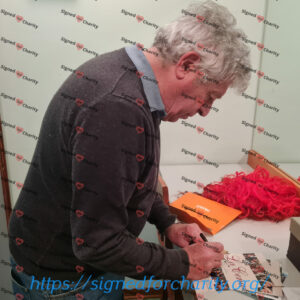


Description
RUGGERO DEODATO BIOGRAPHY:
Ruggero Deodato (born 7 May 1939) is an Italian film director, and has also performed as both a screenwriter, and more recently an actor in both his own and other projects. His career has spanned a wide-range of genres including peplum, comedy, drama, poliziottesco and science fiction, yet he is perhaps best known for directing violent and gory horror films with strong elements of realism. His most notable film is Cannibal Holocaust, considered one of the most controversial and brutal in the history of cinema, which was seized, banned or heavily censored in many countries. It is also cited as a precursor of found footage films such as The Blair Witch Project and The Last Broadcast. The film strengthened Deodato’s fame as an “extreme” director and earned him the nickname “Monsieur Cannibal” in France. Deodato has been an influence on film directors like Oliver Stone, Quentin Tarantino and Eli Roth.
Early life and career
Deodato was born in Potenza, Basilicata, and moved to Rome with his family as a child. He went to Denmark and started as a musician playing piano and conducting a small orchestra at 7 years old. Once back to Italy, he quit music after his private teacher sent him away for playing by ear. Deodato grew up on a farm and at eighteen grew up in the neighborhood where Rome’s major film studios are located. Through a friendship with the son of Rossellini, it was there that he learned how to direct under Roberto Rossellini and Sergio Corbucci; he helped to make Corbucci’s The Slave and Django as an assistant director. Later on in the 1960s, he directed some comedy, musical, and thriller films, before leaving cinema to do TV commercials. In 1976 he returned to the big screen with his ultra-violent police flick Live Like a Cop, Die Like a Man. In 1977 he directed a jungle adventure called Last Cannibal World (also known as Jungle Holocaust) starring British actress Me Me Lai with which he ‘rebooted’ the cannibal film / mondo genre started years earlier by Italian director Umberto Lenzi.
Success and controversies
Late in 1979 he returned to the cannibal subgenre with the incredibly controversial Cannibal Holocaust. The film was shot in the Amazon Rainforest for a budget of about $100,000, and starred Robert Kerman, Francesca Ciardi, and Carl Gabriel Yorke. The film is a mockumentary about a group of filmmakers who go into the Amazon Rainforest and subsequently stage scenes of extreme brutality for a Mondo-style documentary. During production, many cast and crew members protested the use of real animal killing in the film, including Kerman, who walked off the set. Deodato created massive controversy in Italy and all over the world following the release of Cannibal Holocaust, which was wrongly claimed by some to be a snuff film due to the overly realistic gore effects. Deodato was forced to reveal the secrets behind the film’s special effects and to parade the lead actors before an Italian court in order to prove that they were still alive. Deodato also received condemnation, still ongoing, for the use of real animal torture in his films. Despite the numerous criticisms, Cannibal Holocaust is considered a classic of the horror genre and innovative in its found footage plot structure. Deodato’s film license was temporarily revoked and he would not get it back until three years later, which then allowed him to release his 1980 thriller The House on the Edge of the Park, which was the most censored of the ‘video nasties’ in the United Kingdom for its graphic violence. His Cut and Run is a jungle adventure thriller, containing nudity, extreme violence and the appearance of Michael Berryman as a crazed, machete-wielding jungle man.
Late career
In the 1980s, he made some other slasher/horror films, including Body Count, Phantom of Death and Dial Help. In the 1990s he turned to TV movies and dramas with some success. In 2007, he made a cameo appearance in Hostel: Part II in the role of a cannibal. Deodato has made about two dozen films and TV series, his films covering many different genres, including many action films, a western, a barbarian film and even a family film called Mom I Can Do It. He is also helping to develop a cannibal-themed vidoe game called Borneo: A Jungle Nightmare.
MASSIMO ANTONELLO GELENG BIOGRAPHY:
Massimo Antonello Geleng (Milan, june 26 1946) is an art director, production and costume designer. He is the son of Rinaldo Geleng, roman painter and poster designer that had german origins, that followed in his father’s footsteps to then specialize in scenography and theatrical staging. He has created many sets for famous italian film with directors such as Dario Argento and Michele Soavi. He won a prize, the David di Donatello, as the best scenographer of 1994 for the movie “Dellamorte Dellamore”.